
‘Step Up Your Resistance Festival’ advocates resistance through art, music and local government engagement
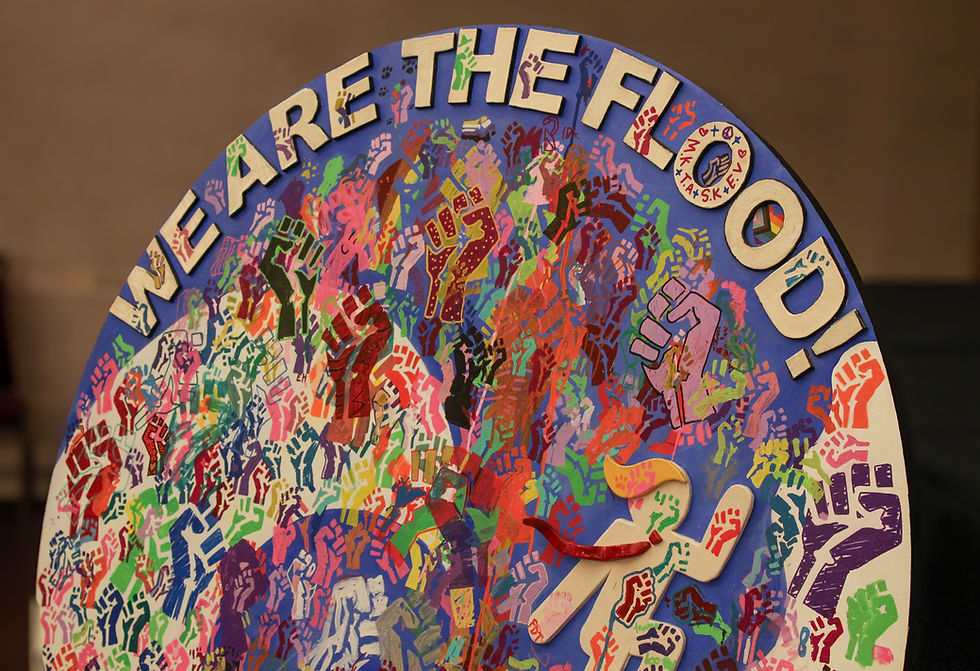
On Nov. 22, the “Step Up Your Resistance” festival hosted over 60 attendees for a day of workshop, music and art framed around local political issues and civic engagement. The event was held in the St. Mark Lutheran Church in Salem and was organized by One Million Rising, a subsidiary program of the “No Kings” organization.
A week after the event, which included discussions on mitigating the effects of local Immigration and Customs Enforcement (ICE) activity, the Salem city council pushed back against ICE by declaring a state of emergency.
To start the event, participants were provided packets outlining the schedule and lyric sheets for group singing, held together by a paperclip as a subtle nod to history. An attached card explained that during World War II, Norwegians wore paperclips as a quiet act of resistance against Nazi occupation. Organizers of the event wore frog-themed headbands referencing the “Portland Frog” as a way to identify themselves. A mural titled “We Are the Flood” invited participants to paint resistance fists, symbolizing an opposition to authoritarian systems.
The pastor of St. Mark Lutheran Church addressed the attendees, briefly speaking his beliefs of overlapping values between human rights activists and Christians. Music was a central feature of the event thereafter, with Peter Bergel, one of the organizers, performing protest songs such as “Which Side Are You On?” with his own lyrics, leading attendees to sing. Virginia Stapleton, a former Salem city councilor running for Oregon State Senate District 11 in the 2026 general election, gave a morning message concluded by the statement, “Fascist governments cannot take joy or hope.”
Speakers encouraged attendees to take civic action, including attending city council meetings, submitting public comments and supporting marginalized voices. Organizers highlighted PeoplesAction.org, which is a national progressive advocacy and political organization in 29 states in the U.S.
A morning workshop on human rights observer training, organized by a leader from Latinos Unidos Siempre who wished to remain anonymous, emphasized immigrant justice and civil rights. Human rights observers, as described by the leader, act as neutral witnesses who document civil rights violations, including activity by police, U.S. Immigration and Customs Enforcement (ICE) and political groups. Observers are not lawyers: they do not give legal advice and do not physically or verbally interfere with enforcement actions, the speaker said. Human rights observers are intended to serve as a resource for victims by collecting information that can later be used in legal cases.
Attendees were provided with two resources for reporting and support: Portland Immigrant Rights Coalition (PIRC) for reporting ICE activity in protected locations, and Equity Corps of Oregon (ECO), a statewide program under Oregon Worker Relief that provides legal support related to immigration status.
The training emphasized three primary methods of documentation: recording from a phone, taking notes on paper, and documenting vehicle interactions. If approached by police or ICE agents, participants were encouraged to record the interaction, narrating time, location and date when possible, and announcing themselves as human rights observers.
Constitutional protections highlighted during the morning workshop included the First Amendment, which covers the freedom of press, speech and assembly, and the Fourth Amendment, which protects against unreasonable searches and seizures. Attendees were advised to secure phones with passwords that do not rely on biometrics to prevent bypassing if devices are taken. The resource wehaverights.us was shared for further guidance.
Concerns raised during the workshop included ICE presence on tribal lands, recent arrests on Lancaster Drive and tactics such as agents using out-of-state license plates or presenting warrants not signed by a judge. The workshop organizer concluded by calling for Salem to declare a state of emergency to protect the community and to withdraw from lawsuits challenging Oregon’s sanctuary law. Following this demand, the Salem Reporter later noted on Dec. 1 that the city council declared a state of emergency in response to federal agents violating constitutional rights through immigration enforcement.
Before the afternoon session, Salem Councilor Vanessa Nordyke, who is running for mayor against incumbent Julie Hoy, spoke to attendees. Nordyke emphasized diversity and community advocacy, stating, "Change is coming. If you are not outraged, you are not paying attention. … The notion that local politics doesn’t matter is not true.” Nordyke encouraged residents to attend council meetings and engage directly with those in leadership positions.
An afternoon workshop titled “Targeted Boycott” by Matthew Boulay focused on boycotts and coalitions. Boulay discussed stopavelo.org as the head of the national coalition, a campaign against Avelo Airlines, which has been linked to deportation flights. He explained that boycotts can be effective tools when communities unify around accessible information. Boulay noted that the boycott has led to route cancellations in multiple cities and pressured Avelo to suspend flights in some regions.
The final session was led by Kathleen, a retired city manager with 30 years of experience in local government. Kathleen, who only gave her first name to The Collegian, explained the structure of Salem’s council, the role of managers and the pressure points that influence policy. These points include campaign donors, unions and regulations, and she advised attendees to review council agendas, attend meetings, build coalitions and remain in contact with all council members. She emphasized focusing demands on issues within the city’s jurisdictional authority.
Following these sessions, the festival concluded with Bergal leading another song, “Hope Lingers On,” by Low Lilly. Attendees sang, “I will not hate, and I will not fear / In our darkest hour, hope lingers here.”


Comments